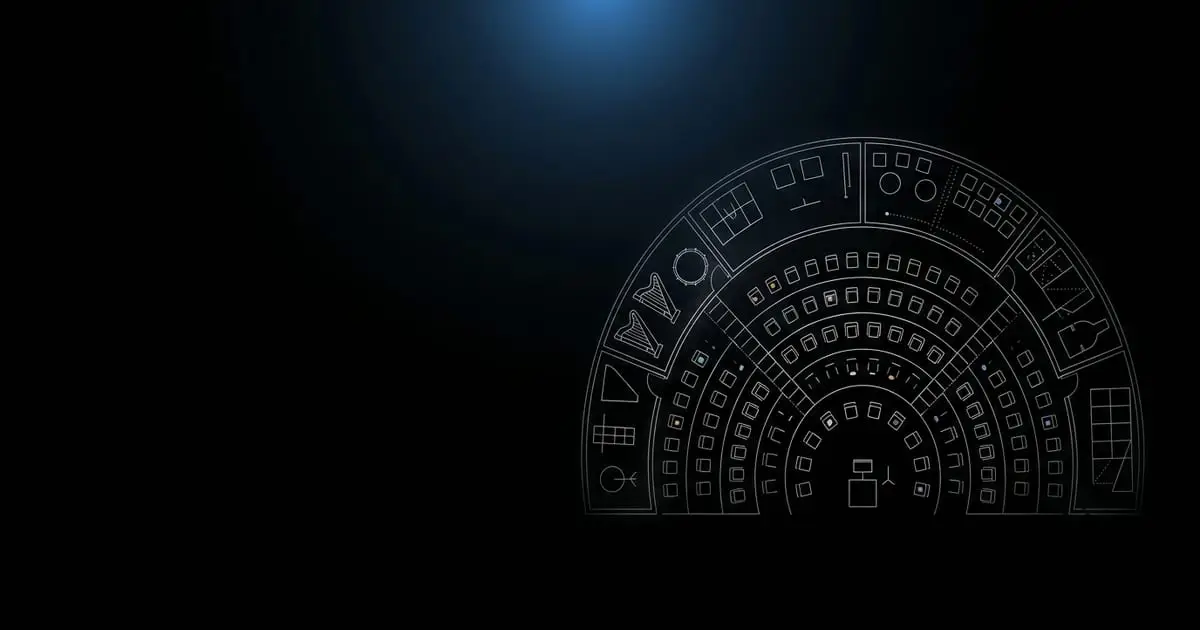
An orchestra seating chart decides who hears whom. Strings form a semicircle at the front, winds sit in the middle, and the loudest instruments go at the back. There are two main string layouts, and school orchestras usually use a simplified version of one of them. Build yours with your roster in the band and orchestra seating chart generator; put the section (Violin 1, Viola, Cello) after each name and sections stay together.
The two string layouts
American (most common today). From the conductor’s left to right: first violins, second violins, violas, cellos. Basses stand behind the cellos on the right. This layout spread in the 20th century and is the default in most US orchestras.
European (antiphonal). First violins on the conductor’s left, second violins on the right, with cellos and violas between them. Basses behind on the left. Composers before the 20th century often wrote with this layout in mind, so some orchestras use it for that music, with violin parts answering each other across the stage.
| Position | American | European |
|---|---|---|
| Front left | First violins | First violins |
| Inner left | Second violins | Cellos |
| Inner right | Violas | Violas |
| Front right | Cellos | Second violins |
| Basses | Behind cellos (right) | Behind left |
Full orchestra
Behind the strings, in a typical setup:
- Woodwinds in the center: flutes and oboes in the first row, clarinets and bassoons behind them. Principal players sit in the middle of their rows so they can hear each other.
- Horns usually to one side behind the woodwinds, often on the left so their bells face the back wall and the sound reflects forward.
- Trumpets, trombones and tuba behind the woodwinds.
- Timpani and percussion at the back.
- Harp usually on the left, near the first and second violins.
- Piano or celesta, if used, to one side.
String orchestra
Without winds, the strings spread into a wider semicircle with basses at the back right. The concertmaster sits on the outside of the first stand of first violins. Each stand has two players: the “outside” player (nearer the audience) and the “inside” player, who turns the pages.
Chamber orchestra
20 to 40 players. Same layout, fewer stands per section, and the winds often in a single row. The conductor may stand closer, and in baroque groups the leader may conduct from the violin.
School orchestra tips
- Confident players on the outside of the front stands, so the section follows them.
- Avoid long thin rows. Two or three stands deep per section helps players hear the leader.
- Cellos where the conductor can see their bows, since they often carry the bass line.
- Basses close to the cellos. They share the bass line in most school music.
Making the chart in the generator
The generator uses semicircle rows around the conductor. For strings:
- Set 2 to 4 rows depending on size, with the front row seat count matching your first-row players.
- Paste the roster as “Name, Violin 1”, “Name, Viola” and so on.
- Press Auto-arrange. Sections stay together and sit side by side.
- Swap players by tapping, lock the concertmaster and principals, then print.
The generator places sections by group, not by the American or European order, so drag or swap the sections into the order you want after the first arrange.
Sample school string orchestra (30 players)
| Section | Players | Stands |
|---|---|---|
| First violins | 8 | 4 |
| Second violins | 8 | 4 |
| Violas | 5 | 3 |
| Cellos | 6 | 3 |
| Basses | 3 | 2 |
In the American layout, first violins sit front left, seconds behind or beside them, violas front right of center, cellos front right, and basses behind the cellos. Two players share each stand.
Stand partners
- Outside player (nearer the audience) plays the top note in divisi and leads bowings for the stand.
- Inside player turns pages and plays the lower note in divisi.
- Pair confidence: put a secure player with a less secure one, especially in school groups.
- Rotate stand partners each term so students learn from different players.
Common orchestra seating mistakes
- Sections too spread out. Players at the edges cannot hear their leader.
- Basses far from cellos. They often share the bass line and need to hear each other.
- Winds hidden behind tall players. In school orchestras, raise the winds on risers if you can.
- No clear view of the conductor. Check every chair’s sightline before the first rehearsal.
Changing the layout for a concert
Many school and community orchestras use one layout for rehearsals and adjust it for concerts:
- Wider stage: spread the semicircle so the outer stands can see the conductor.
- Shallow stage: fewer rows, more players per row.
- Risers available: put winds and brass on risers so their sound clears the strings.
- Soloist: leave space beside the conductor, usually on the left between the conductor and the first violins.
Building the chart step by step
- List every player with their section, for example “Maya Bell, Violin 1”.
- Decide stands per section, two players per stand.
- Set the number of rows in the generator so the front row holds the first stands of each section.
- Press Auto-arrange to keep sections together, then swap sections into American or European order.
- Lock the concertmaster and principal players.
- Print the chart for the music folders and post one copy on the rehearsal room door.
Save the finished chart with Save backup so you can open it again next term instead of starting over.
For wind band and jazz setups, see middle school band seating. Choirs are covered in choir seating arrangements. Teaching general classes too? See classroom seating arrangements.